
Pricing is one of the hardest decisions for tutors. Too low and you burn out working long hours for little return. Too high and students go elsewhere. Most tutors pick a number that "feels right" and never revisit it.
Here's a more systematic approach.
Know Your Market
Tutoring rates vary dramatically by subject, location, and format. Some reference points for 2026:
| Factor | Lower Range | Higher Range |
|---|---|---|
| School subjects (math, English) | $15–25/hr | $30–50/hr |
| Test prep (SAT, IELTS, ЕГЭ) | $25–40/hr | $50–100/hr |
| University level | $30–50/hr | $60–120/hr |
| Specialized skills (coding, music) | $20–40/hr | $50–150/hr |
| Online vs in-person | Online ~10–20% less | In-person premium |
| Group vs individual | Group per-student ~40–60% less | Individual full rate |
These numbers shift based on your city, your country's market, and the subject's demand. For a deeper data-driven look, see Average Tutoring Rates in 2026. Check local tutor listings and competitor prices for accurate reference.
Factors That Should Influence Your Price
Your Experience
A tutor with 5 years of experience and proven results commands higher rates than someone starting out. Credentials matter too — a degree in the subject, teaching certifications, or a track record of student results all justify higher pricing.
If you're just starting, price competitively to build a client base. Raise rates once you have testimonials and waitlists.
Preparation Time
A 60-minute lesson rarely takes 60 minutes of your time. You spend time: - Preparing materials and exercises - Reviewing student progress - Creating homework and checking it - Communicating with parents
If preparation adds 30 minutes per lesson, your effective rate drops by a third. Price your lessons to account for this.
Your Costs
Even online tutoring has costs: - Platform subscriptions - Screen sharing / video tools - Teaching materials - Internet and electricity - Self-employment tax (often 15–30%)
Calculate your monthly costs and make sure your rates cover them with margin.
Subject Difficulty
Hard-to-find subjects command premium prices. If you're one of three people in your city who tutors AP Physics, you can charge more. If there are hundreds of English tutors, competition keeps prices lower.
Student Commitment
Regular students are worth more than one-off sessions: - Lower marketing cost (you don't need to find new students every week) - Predictable income - Better teaching outcomes (continuity)
Reflect this in your pricing: offer slightly lower per-lesson rates for committed students (weekly recurring lessons) vs. one-off sessions.
Pricing Models
Per Lesson
The most common model. Student pays a fixed amount per lesson. Simple, clear, easy to track.
Best for: Most tutoring situations. New tutors. Students who want flexibility.
Package Deals
Sell lessons in bundles: 4, 8, 10, or 20 lessons at a discounted rate. The student pays upfront and gets a per-lesson discount (typically 5–15%).
Benefits: - Guaranteed income for multiple weeks - Student commitment (they're more likely to actually attend) - Less time spent on payment collection
Best for: Students preparing for exams. Long-term tutoring relationships.
Monthly Subscription
Student pays a fixed monthly fee for a set number of lessons per week. Common for regular students who come 2–3 times a week.
Benefits: - Predictable monthly income - Simple billing (one payment per month) - Student perceives it as a service, not individual transactions
Best for: Tutors with regular, committed students.
Hourly Rate
Less common for tutoring but used for consulting-style sessions. Student pays for the actual time spent, including preparation if agreed.
Best for: University-level tutoring. Advanced consulting.
Setting Up Packages in TeachersFlow
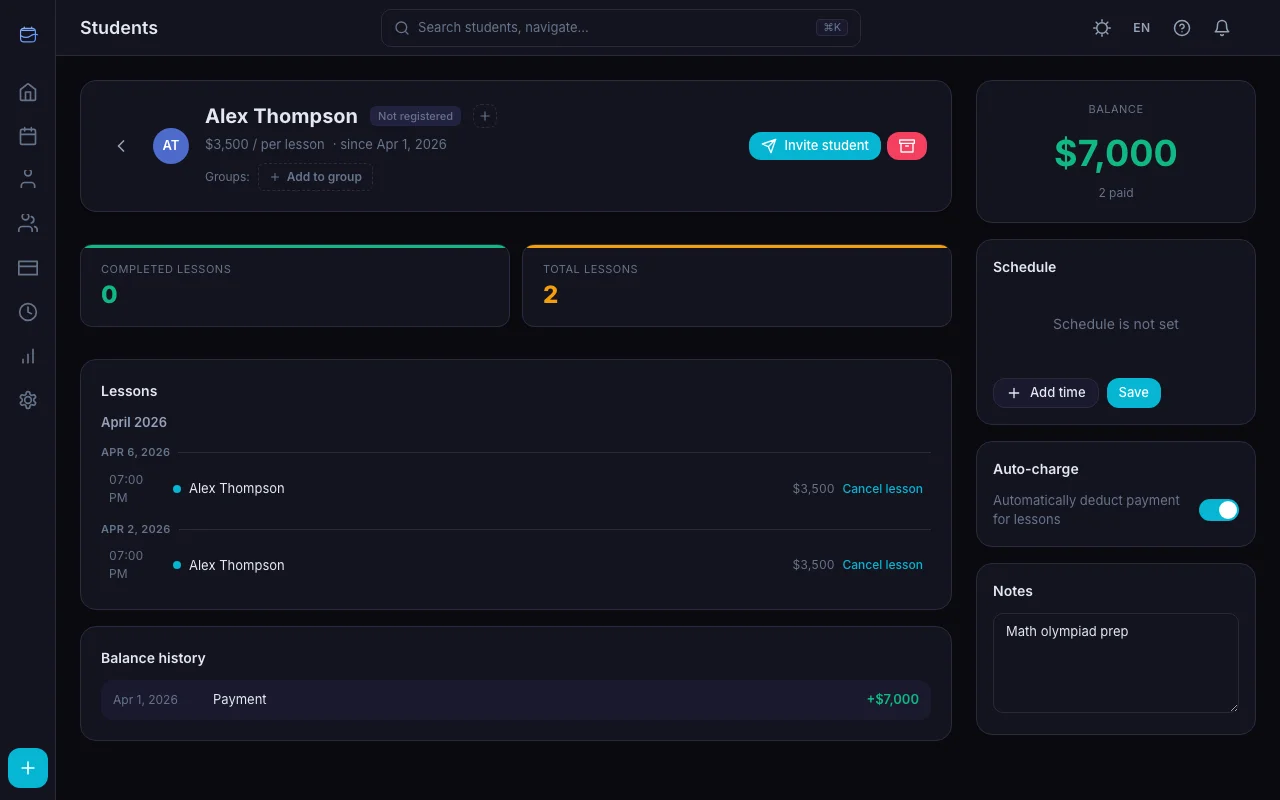
TeachersFlow's balance model maps naturally to packages:
- Set the lesson price for the student (e.g., $30)
- Student pays for X lessons — you add the total to their balance (e.g., $300 for 10 lessons)
- Auto-charge deducts per lesson — each completed lesson takes $30 from the balance
- Student can track remaining lessons via their portal balance
No need for separate "package" logic — the balance system handles it automatically. You can even set a different price per student, supporting "regular student" vs. "one-off session" pricing.
When to Raise Your Rates
Signs it's time for a rate increase:
- You're fully booked — if you have a waitlist, demand exceeds supply. Raise prices.
- You haven't raised in a year — inflation alone justifies 3–5% annual increases
- Your skills have improved — new certifications, better results, more experience
- You're undervaluing your time — if your effective hourly rate (including prep) is below minimum wage, something's wrong
- Market rates have moved — check competitor pricing annually
How to Communicate a Price Increase
- Give 1–2 months notice: "Starting September, my rate will be $35/lesson."
- Explain briefly: "This reflects [inflation / my updated qualifications / increased demand]."
- Grandfather existing packages: honor the old rate for pre-purchased lessons
- Don't apologize — you're running a business
For a complete script and timing guide, read How to Raise Your Tutoring Rates Without Losing Students.
Common Mistakes
Pricing too low to attract students. Low prices don't always mean more students — they can signal low quality. A moderate price with good reviews beats a rock-bottom price.
Not accounting for no-shows. If 10% of your lessons cancel last-minute, your effective income is 10% lower. Build a clear cancellation policy (and use auto-charge for cancelled lessons when appropriate) — see Stop Losing Money on Lesson Cancellations.
One price for everyone. Different students have different situations. It's okay to charge more for exam prep vs. homework help, or for Saturday evenings vs. weekday mornings.
Never raising rates. Your rent goes up every year. Your rates should too.
Track It All
Whatever pricing model you choose, tracking matters. TeachersFlow tracks every lesson, payment, and balance change automatically — so you always know where you stand financially.
14 days of full Pro access — no card required.