
You've decided to tutor. You know your subject. Maybe you've set up a scheduling tool. But you have zero students. Where do they come from?
Here's what actually works — ranked from free and effective to paid and scalable.
Free Channels
1. Your Existing Network
The fastest path to first students. Tell everyone you know:
- Post on your personal social media (Instagram, Facebook, LinkedIn)
- Message friends and family directly: "I'm starting private tutoring in [subject]. Know anyone who needs help?"
- Tell colleagues, former classmates, university contacts
- Ask parents in your social circle
Most tutors get their first 1–3 students from personal connections. It costs nothing and trust is built in.
2. Local Community Groups
Facebook groups, Nextdoor, neighborhood chats, school parent groups, university forums. Post something like:
"Hi, I'm [Name], a [subject] tutor with [X years experience / degree in Y]. I'm taking new students for online/in-person lessons. Message me for details."
Be specific about your subject and format. Generic "I tutor everything" posts get ignored.
3. Word of Mouth From Current Students
Once you have even 1–2 students, referrals kick in:
- Ask happy students/parents to recommend you
- Offer a small incentive (one free lesson for a successful referral)
- Make it easy: "If you know anyone who needs [subject] help, I have a few slots open."
Referrals convert at 3–5x the rate of cold leads because trust transfers.
4. Tutor Directories
Free listings where students search for tutors:
- Wyzant (US) — large marketplace, takes a commission
- Superprof — international, free to list
- Tutor.com — application-based
- Preply — for language tutors, commission-based
- Profi.ru / Repetitor.ru (Russia) — local marketplaces
Create a strong profile: clear photo, specific subjects, experience highlights, and your teaching approach. A generic profile gets lost.
5. Social Media Content
This is a longer game but builds authority:
- Short educational posts/videos about your subject
- "Quick tip" reels (30–60 seconds solving a common problem)
- Student success stories (with permission)
- Behind-the-scenes of your teaching process
You don't need thousands of followers. Even 50 views from the right audience can bring a student.
Paid Channels
6. Local Advertising
- Flyers at schools, libraries, community centers
- School newsletter ads (many schools sell ad space)
- Local newspaper classifieds
- Bulletin boards at universities
Cost: minimal ($20–50 for printing). Works best for in-person tutoring in a specific area.
7. Online Ads
- Google Ads — target "[subject] tutor in [city]" searches
- Social media ads — Facebook/Instagram targeted to parents in your area
Cost: $5–20/day. Can be effective but requires testing. Start small, measure, and scale what works.
8. Tutoring Agencies
Apply to local tutoring companies. They find students and take a cut (usually 30–50%). You lose margin but gain students without marketing effort.
Good for: beginners who need experience and initial clients. Less good long-term because of the commission.
What Actually Matters
Your First 5 Students Are the Hardest
After 5 students, referrals start working. After 10, you likely have a waitlist forming. The first 5 require active effort.
Quality Over Quantity
One committed student who stays for a year is worth more than five who quit after one lesson. Focus on retention:
- Be prepared for every lesson
- Communicate clearly (schedule, payment, expectations)
- Show progress — students (and parents) need to see results
- Be reliable — show up on time, every time
Professionalism Matters Early
Even with one student, act like a professional:
- Have clear pricing
- Use a scheduling system (not just texting back and forth)
- Send lesson reminders
- Track payments properly
This isn't just about image — it's about retention. Students who feel they're dealing with a professional stay longer.
Setting Up for Growth
Once you have your first students, the operational side needs to keep up:
- Track every student — names, contacts, schedules, payment status
- Set up recurring schedules — don't manually book the same lesson every week
- Automate payments — prepayment balance eliminates payment conversations
- Send reminders — reduces no-shows and last-minute cancellations
- Share a student portal — students check their schedule and balance themselves
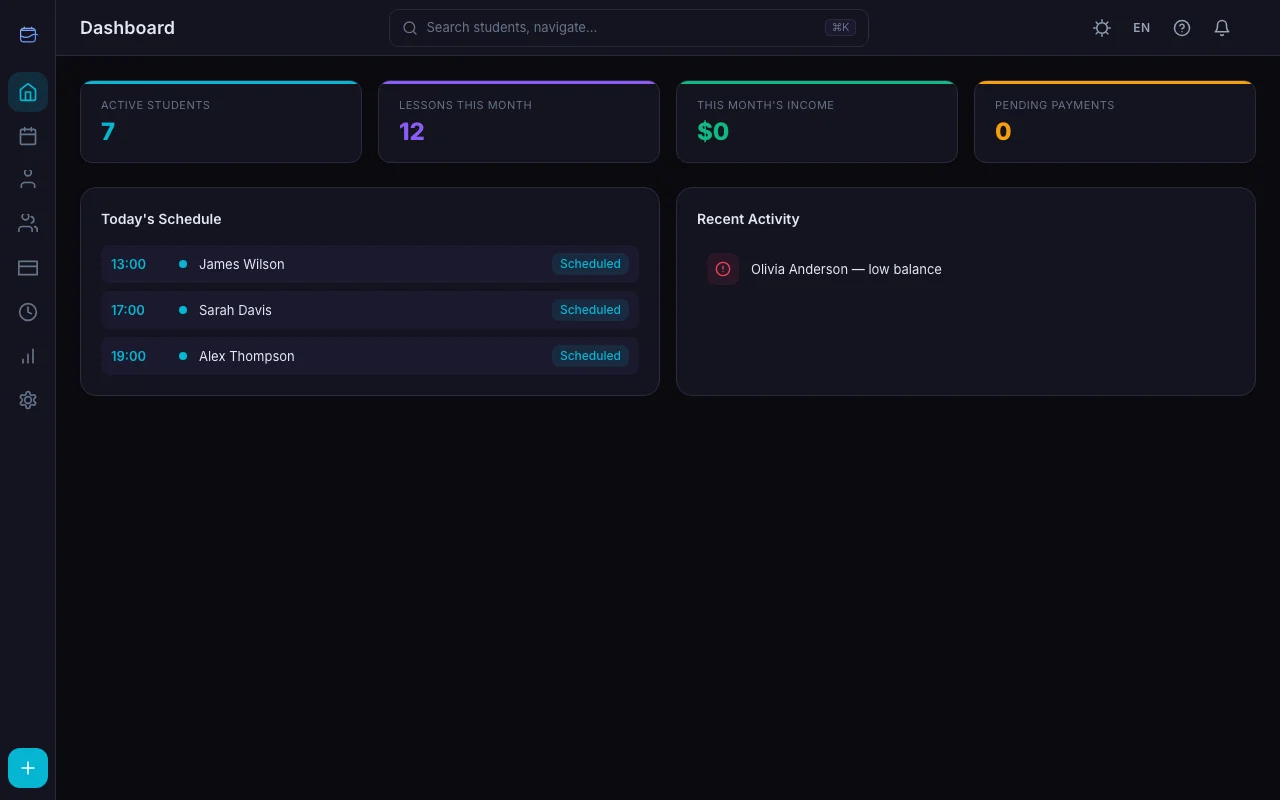
TeachersFlow handles all five. You add a student, set a schedule, enable auto-charge, and share the portal link. Takes 2 minutes per student. New here? Get Started in 5 Minutes.
The Timeline
| Phase | Students | Time | Focus |
|---|---|---|---|
| Launch | 0 → 1–2 | Week 1–2 | Personal network, community groups |
| Early growth | 2 → 5 | Month 1–2 | Directories, content, referral asks |
| Traction | 5 → 10 | Month 2–4 | Referrals, repeat business, niche down |
| Stability | 10 → 15+ | Month 4–6 | Waitlist, rate increases, systemize |
Most tutors reach 10 students within 3–4 months if they actively market. The ones who stall usually stopped marketing after getting their first 2–3 students.
Start Organized
Don't wait until you have 10 students to get organized — start from student #1. TeachersFlow gives you scheduling, payments, and a student portal from day one. The free plan supports up to 5 students — exactly what you need to get started.
14 days of full Pro access — no card required.